
The real estate market in Indonesia looks attractive from the outside due to fast-growing cities, booming tourism, and headlines about rising villa returns.
Analysts expect the real estate market in Indonesia to reach around USD 64.78 billion in 2024 and keep growing at about 5.82% per year to 2029, according to Cekindo’s Indonesian real estate report.
But if you’re asking, can foreigners buy property in Indonesia, and how they actually do it legally, the answer is more complex.
Foreigners face strict land-ownership rules, but there are regulated paths, such as Hak Pakai, long leases, and PT PMA structures, that can still support serious property investment in Indonesia.
This guide breaks down how buying property in Indonesia for foreigners actually works:
- Which ownership structures are legal?
- How are regulations changing?
- What does the property tax in Indonesia look like?
- The key steps from shortlisting a villa or apartment to signing the final deed.
Most importantly, you’ll see the common traps that cost foreign buyers time, money, and sleep. The goal is to help you avoid them so you can make clearer, safer, and smarter property investment in Indonesia decisions before you move or invest.
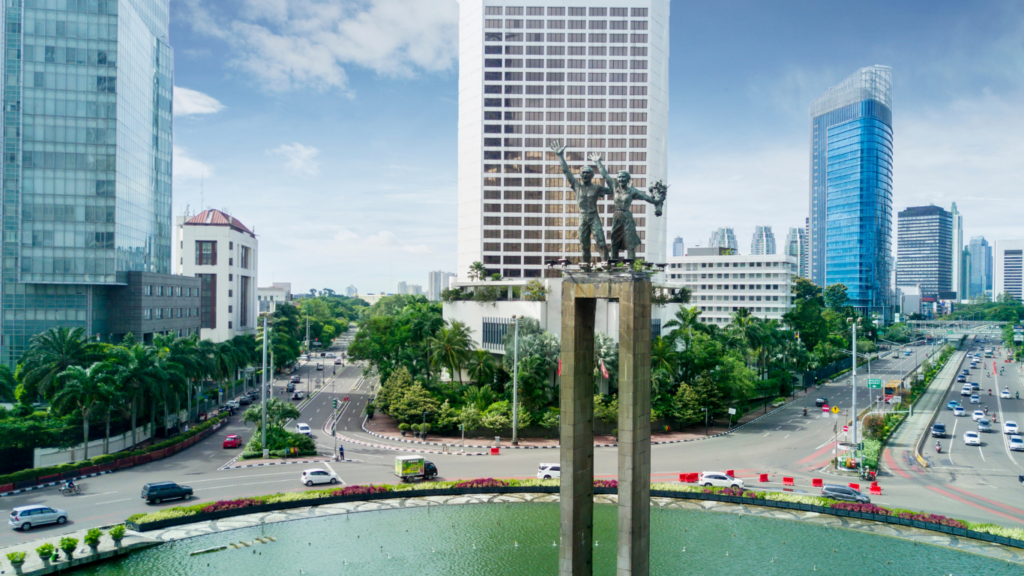
Understanding the Real Estate Market in Indonesia
By the end of May 2021, the Ministry of Public Works and Public Housing (PUPR) recorded 312,290 housing units, contributing IDR 468.22 trillion (USD 29.85 trillion) to GDP in 2021.
Urbanisation and new infrastructure corridors around Jakarta, Bali, IKN (Nusantara Capital), Surabaya, Tangerang, and secondary cities keep driving long-term housing demand.
For lifestyle and rental plays, foreigners buy property in Indonesia mainly in Jakarta, Bali, Batam, and a few emerging tourism hubs.
Bali alone attracted over 5.2 million international visitors and over 9.4 million domestic tourists in 2023, sharply boosting occupancy and daily rates for villas and holiday rentals, according to Tempo’s coverage of Bali overtourism.
Jakarta appeals for business and expat housing, while Batam benefits from proximity to Singapore and special economic zones.
Choosing the right city and micro-location directly shapes the outcome of your property investment in Indonesia. Capital growth, year-round rental demand, and realistic exit options can look very different between a central Jakarta apartment, a Canggu villa, and a speculative plot in an unproven area.

How Foreigners Buy Property in Indonesia Legally
For clarity, can foreigners buy property in Indonesia?
Yes, but only under specific legal frameworks. Foreign buyers cannot hold freehold (Hak Milik) land. Instead, buying property in Indonesia for foreigners must use regulated rights such as:
- Hak Pakai (Right to Use),
- Hak Guna Bangunan (Right to Build) via a PT PMA (Foreign Investment Company)
- Long-term leasehold structures, or
- Mixed marriage ownership with Indonesian permanent residence
Here’s the detailed comparison between the options:
| Aspect | Hak Pakai (Right to Use) | HGB via PT PMA (Right to Build) | Long-term Leasehold (Hak Sewa) |
| Who holds it? | Eligible foreigners, Indonesian individuals/entities | PT PMA (foreign-owned company). | Any party (foreigner or Indonesian) via contract. |
| Nature of right | Registered real right to use land/building. | Registered real right to build and use on land. | Contractual right to use property for a term. |
| Typical duration | 30 years + extensions up to ~80 years (subject to approval). | 30 years + extensions/renewals up to ~80 years. | Commonly 25–30 years initially, with optional extensions if agreed. |
| Use/live | Residential or approved use as per license and zoning. | Residential or commercial use aligned with PT PMA’s business scope and zoning. | Residential or commercial use as defined in the lease and zoning. |
| Rent out | Possible if zoning/licence allows. Good for mid–long-term rental. | Designed for rental/operational business (villas, hotels, commercial). | Subletting is allowed only if written in the lease. It varies by contract. |
| Sell/transfer | Right can usually be transferred to another eligible party, with tax implications. | PT PMA can sell the HGB or transfer company shares. | The remaining lease term may be assigned if the contract permits. |
| Inheritance | Can pass to heirs who meet requirements. Otherwise, it must be transferred or released. | PT PMA shares can be inherited or transferred. | A lease can be inherited if the contract allows and the heirs accept the terms. |
| Registration | Recorded at the land office. Appears on the certificate. | HGB registered at the land office in PT PMA’s name. | Usually not a land title. Based on a notarial lease contract. |
| Main advantages | Clear, registered title for individuals. More “ownership-like” than a simple lease. | Strong control for business, bankable for some commercial financing. | Simpler setup, common in Bali and tourist markets, lower entry cost. |
| Key risks/limits | No freehold. Depends on policy and proper renewals. | Higher setup and compliance costs. Must maintain the company and reporting. | Purely contractual. Renewal is not guaranteed, with high dependence on the landlord and contract quality. |
| Best suited for | Foreign individuals wanting regulated long-term use of a home/unit. | Investors running structured property investment in Indonesia (rental/operating assets). | Lifestyle buyers and smaller investors are comfortable with lease risk and contract complexity. |
To protect your position when foreigners buy property in Indonesia, it is critical to use these recognised structures and avoid informal nominee setups, which legal experts warn are risky, unenforceable, and can lead to total loss of control over the asset.
Heybali reported that in 2025, there were 30 people who became the victims of Bali investment scams, losing more than USD 5 million. This only came from one property scam case through ghost permits and a crypto conundrum.

Step-by-Step Guide to Buying Property in Indonesia for Foreigners
A smart step-by-step guide to buying property in Indonesia for foreigners starts with clarity. Decide whether the asset is for your own use, mixed-use, or pure rental, then set a realistic budget including taxes and legal fees.
Shortlist regions that fit your goals. For instance, Jakarta for business, Bali for lifestyle and tourism demand, and Batam for proximity to Singapore as an easy international exposure.
Next, research suitable listings through trusted channels. You can use leasehold property listings on Indo Property Hub to explore vetted options and compare areas side by side.
Throughout buying property in Indonesia for foreigners, work with:
- A licensed real estate agent (market access, negotiation)
- A notary/PPAT (deeds, registration, title checks)
- Independent legal counsel (structure, compliance, risk)
This team protects your property investment in Indonesia from defective titles and illegal nominee arrangements.
As foreigners buy property in Indonesia, it’s safer to rely on licensed agents, reputable developers, and vetted online platforms rather than informal contacts, which are often linked to disputes and unclear titles.
You can find reputable developers and reliable local-based property agents through the Indo Property Hub services directory.
Once you select a property, the flow usually is:
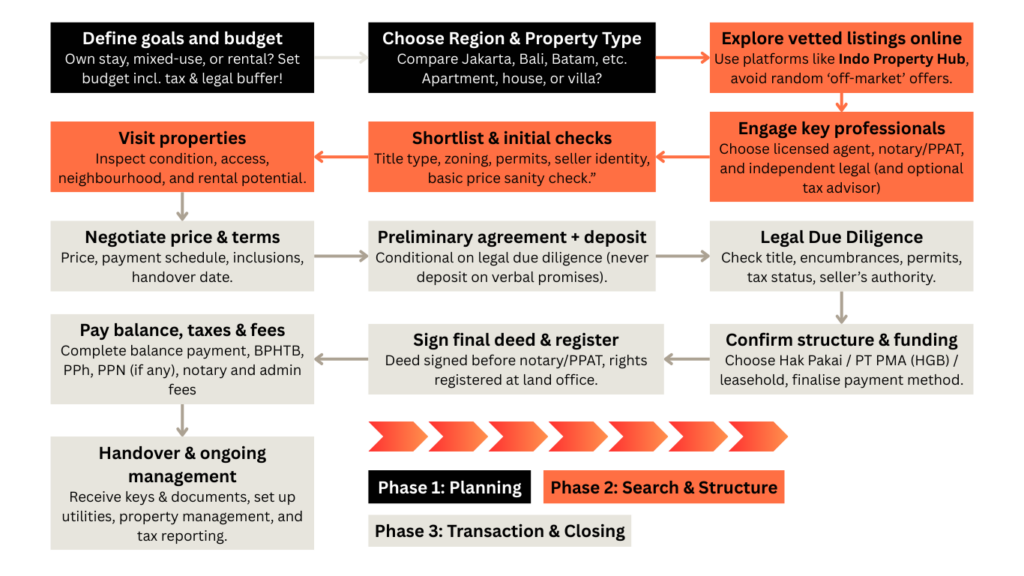
Following these steps keeps your transaction structured, well-documented, and significantly lower risk.

Property Tax in Indonesia: What Foreign Buyers Must Know
When foreigners buy property in Indonesia, tax is a full stack of charges you must budget for. The core property tax in Indonesia is the annual land and building tax (PBB), typically around 0.1–0.5% of the government-assessed value (NJOP), as outlined in Eastern Edge’s guide to Indonesia property tax.
On acquisition, buying property in Indonesia for foreigners usually triggers transfer-related taxes and fees. The BPHTB (Duty on the Acquisition of Land and Building Rights) at 5% of the taxable property value, while sellers are subject to final income tax (PPh) of around 2.5% of the transfer value.
New or off-plan units from VAT-registered developers can also attract PPN (VAT) at an effective 11%, although there are temporary incentives for certain housing segments.
For rental-focused property investment in Indonesia, non-residents are generally taxed at 20% final withholding on gross rental income, while PMA (corporate ownership) rental profits are taxed under Indonesia’s standard corporate tax rate, currently 22%.
Because all these charges directly shape your net yield and exit proceeds, buying property in Indonesia for foreigners should always start with a realistic tax model
The safest approach is to work with a tax advisor who understands foreign ownership structures so your property tax in Indonesia position stays compliant and optimised for long-term returns. You can connect with tax advisors through the Indo Property Hub services directory.

Conclusion: Common Mistakes in Property Investment in Indonesia for Foreigners
Many problems in property investment in Indonesia start with avoidable mistakes. Foreign buyers still get talked into informal nominee schemes, skip proper due diligence, or rely on WhatsApp promises instead of signed contracts.
In a fast-growing real estate market in Indonesia, the cost of being “casual” can be very high. Common red flags include:
- Using nominees instead of legal Hak Pakai, PT PMA, or leasehold
- No independent legal review or title check
- Ignoring zoning, building permits, and property tax in Indonesia
- Paying large deposits on verbal agreements only
Before committing, every buyer should ask:
What is my exit plan?
Think about your timeline, target price, and who your realistic resale market will be before finalising any buying property in Indonesia for foreigners decision.
You don’t need to figure out how foreigners buy property in Indonesia alone, especially on legal structures, tax, and area selection. IndoProperty Hub is a neutral marketplace, not an agent, helping you:
- Compare areas,
- Explore different property types and listings
- Discover ownership options that fit your goals via freehold and other structures
Reach out via WhatsApp or email through our contact page, share your budget, plan, and preferred locations, and let IndoProperty Hub connect you with vetted projects, local agents, and real-estate service providers via the services directory.
That way, you move forward with more clarity and less risk!
FAQs About How Foreigners Buy Property in Indonesia (Quick Answer & 2025 Context)
What Foreigners Should Avoid When Investing
Foreigners should:
- Avoid informal nominee schemes where an Indonesian holds freehold land “on behalf of” them. This is risky and not a secure property investment in Indonesia.
- Never buy without proper due diligence on land titles, zoning, permits, and seller identity.
- Don’t chase only “cheap deals” without understanding the real estate market in Indonesia and realistic rental or resale demand.
Can a Foreign Buyer Sell Property in Indonesia?
Yes, in most cases, a foreign buyer can sell their rights or interests, depending on the structure used. For instance, leasehold rights, Hak Pakai, or shares in a PT PMA.
You should factor in market conditions, taxes, and closing costs, and plan your exit strategy early so foreigners buying property in Indonesia know how and when they can resell.
Can foreigners buy property in Indonesia legally?
Yes, foreigners can buy property in Indonesia, but only under specific schemes such as Hak Pakai (right-of-use), long-term leasehold, or via a PT PMA (foreign-owned company).
These give usage and often rental rights, but are different from full freehold ownership reserved mainly for Indonesian citizens.
Can foreigners own freehold land in Indonesia?
In general, freehold land (Hak Milik) is reserved for Indonesian citizens, not foreigners. Instead, foreigners buy property in Indonesia using long-term leases, Hak Pakai, or PT PMA structures to control and use property while staying within the law.
How much tax do foreign property owners pay in Indonesia?
Foreign owners may face several charges, including annual property tax in Indonesia, transfer taxes on buying/selling, and income tax on rental income.
The exact amounts depend on property value, location, and ownership structure, so it’s essential to model costs early and confirm with a local tax advisor via the Indo Property Hub services directory before committing to buying property in Indonesia for foreigners.
Is it safe to use a nominee to buy property in Indonesia?
Using informal nominee arrangements (putting freehold in an Indonesian’s name for a foreign buyer) is legally risky and not recommended.
To build safer property investment in Indonesia, foreigners should stick to recognised structures such as Hak Pakai, leasehold arrangements, or PT PMA instead.
How long does the buying process take for foreigners?
Once you’ve chosen a property and documents are in order, the process for foreigners buying property in Indonesia typically takes from a few weeks to a few months. Timelines depend on due diligence, fund transfers, notary/PPAT schedules, and how complex your chosen ownership structure is. Using a platform like Indo Property Hub can help make the process quicker and more reliable.